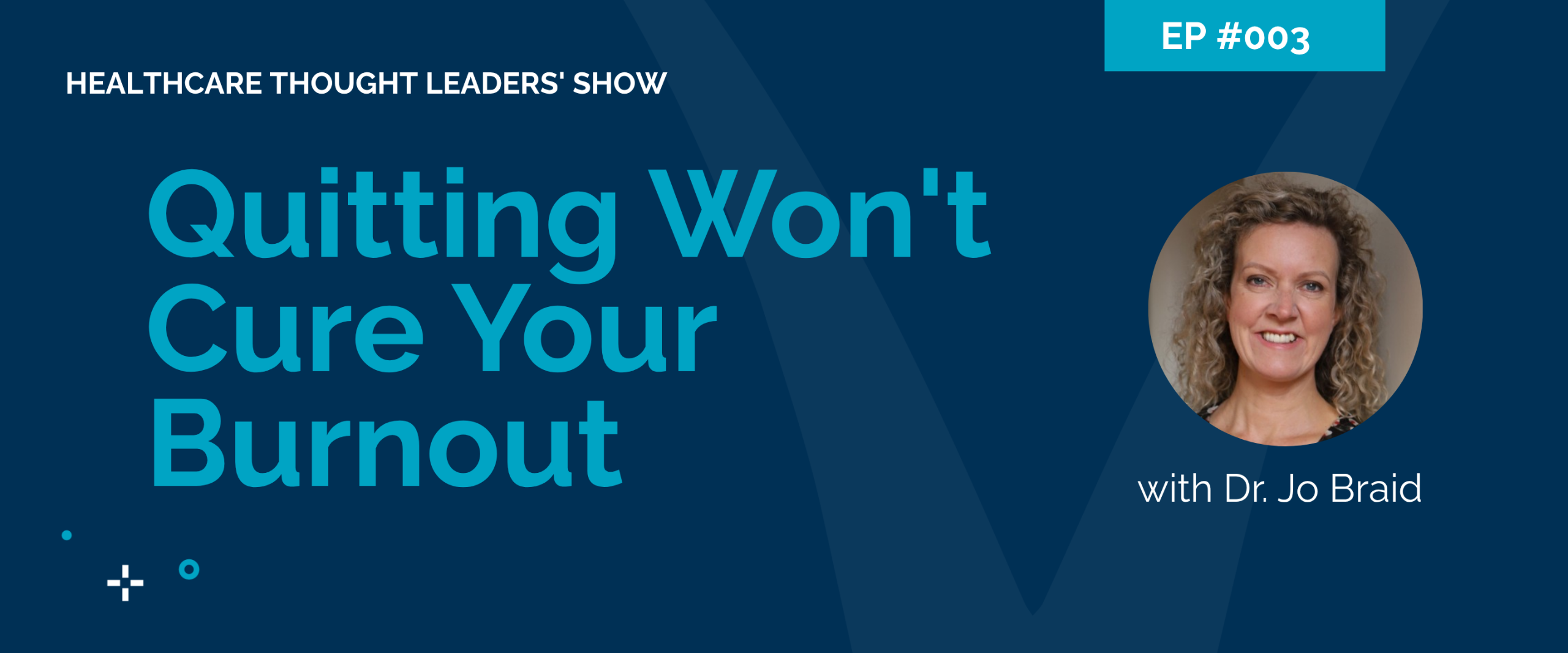
Watch the video...
Read the Transcript...
Megan Walker: Hello, and welcome to the Healthcare Thought Leaders Show. I'm Megan Walker, and today our very special guest is Dr. Jo Braid. Hi Jo, how are you?
Dr. Jo Braid: Great, thank you Megan. How are you?
Megan Walker: Very well, thank you. I'm going to get Jo to do a lovely intro of herself soon, but I came across Jo on LinkedIn, and it really does speak to the power of having a regular social media presence that is genuinely social. I really love what Jo is talking about in burnout, recovery, and preventing burnout. Jo is a healthcare speaker and a burnout expert. As many of you who follow me know, I'm interested in the space of becoming a healthcare thought leader, and I wanted to have this conversation so we can explore how to keep our really valuable clinicians in the profession for longer. If there is that tiredness and that fatigue, then perhaps it doesn't mean leaving the profession. It might just mean it looks a little different. So Jo, how does that sound? Give us a bit of background about yourself.
Dr. Jo Braid: Sure, thank you so much Megan, and yeah, great to connect with you on LinkedIn. So I'm a doctor of over 20 years, and the specialty I've gone into is rehabilitation medicine, particularly traumatic brain injury and spinal cord injury. More recently, within the last five to six years, I've also upskilled as a coach, particularly in leadership. I'm a podcast host of nearly four years and a keynote speaker as well. I've really loved having a creative career, which probably came about from moving rurally. There were fewer medical jobs out this way, so my opportunities to do something differently were maybe broader here, and I've just loved the way this career has unfolded.
Megan Walker: Oh, amazing. That's a really interesting lead-in. I can already hear that necessity has been the mother of creativity for you. Tell us a little bit more about that. How far are you based from a capital city?
Dr. Jo Braid: Great question. We're about three and a half hours from either Canberra or Sydney. We're three hours west over the Blue Mountains in Orange, New South Wales.
Megan Walker: Beautiful. Wonderful. So for many of our clinicians listening who are being pulled towards teaching, advocacy, or the space of thought leadership, let's hear about your journey. You've already talked about moving to a regional area and needing to look at different ways of delivering your message. What else was driving you to step more into this coaching space?
Dr. Jo Braid: Yeah, such a good question. It was when I had three kids under six and I decided to open my own rehab clinic here privately in Orange. It all just stacked, and it didn't happen overnight. Burnout never happens overnight. It is a slow burn and a slow spiral. So I opened that in 2017, and I would say by 2019, 2020 I was just running short on energy, irritability, fuse. I was quite solo with what I was doing as well, very fixed and responsible on the family, but also putting a lot into my clinic.
I ended up having coaching with a doctor who's a coach from the US, and her team, and I absolutely loved the mindset tools that they shared with me. They were so actionable, and I really understood myself a lot better. I love to get behind why things work, you know, Megan. So I decided to upskill in the same training program they had done. Over 200 doctors have gone through this coaching in the US. It was virtual. I did that during COVID, opened up my coaching practice, closed my clinic, and I've still combined my medical career and now my coaching career since 2021. So that was the pivot point: the coaching, and then upskilling in that way.
Megan Walker: That's so inspirational for a lot of people listening. I know a lot have lived experience of either a health tragedy or something that's happened with a family member or personally. It is that burning platform sometimes that you can see: do I keep going the same way and have more of the same? But for you, you were amazingly resourceful in going, "Hang on, I'm going to change this." Would you recommend that for other clinicians listening?
Dr. Jo Braid: Well, I think that's such a good point, Megan, because we can be so committed to our work. We have spent years and years in training and upskilling, getting the experience, the expertise, and the credibility, and it can be so hard to have that idea of quitting. I don't subscribe to the notion that quitting is the solution to burnout, because unless you've really worked on yourself and worked on your mindset, that same person is going to enter another workplace or another kind of work. Particularly with a Type A or high-achieving personality, it's really likely that the burnout would follow you to another workplace as well.
So I think growing that self-awareness, which is what coaching did for me, whether that's coaching or therapy, is often what people need to then reevaluate. Do I go back to the same place, or do I tweak how I am in the same place, so that you can set yourself up for success and sustainability? That's what I particularly work on with clients, rather than another short-lived six months and then going, "I'm in the same place again."
Megan Walker: Yeah, so looking at the patterns underneath that are driving that behaviour. Whether the environment changes, the patterns are still there.
Dr. Jo Braid: Yes, well said. The environment often needs addressing too, and that's a big part of the puzzle, but we might get to that.
Megan Walker: Something that I could see from the outside looking in, that it looks like you've mastered really well, is taking on that position of visibility, which is so important and goes hand in glove with the work that you're doing. If people don't know that you're there, how can you reach and help them? Did you have any hesitation, having been a traditionally trained clinician, and then suddenly putting your face and voice on things? Tell us about that transition.
Dr. Jo Braid: Yeah, it was hard. It definitely was hard. It didn't feel easy, and there are AHPRA rules we have to be clear around, particularly testimonials. It's great, if you've got healthcare practitioners you're working with, to be clear on what they can and can't share. But when I made it quite emotive and talked about shifts that I'd personally had, those resonated and landed with people, and that didn't necessarily seem so bad.
Just doing it regularly, getting that consistency and getting over that hill of "this is new, this is new, this is new," which we have all done in our careers, right? We've all started as a beginner somewhere. It did become easier. Now I engage a social media manager who helps me a lot and really gets my brand and my brain of what to share. So I've outsourced to more support. It's hard at the beginning, and it does get easier. Those seeds you sow through social media, you'll reap them later on, and I'm certainly finding that now, after a lot of time of consistency online, that people definitely know about you.
Megan Walker: I love that. I often say to clients, it's so uncomfortable and so fear-evoking, but channel into the greater good. This is a vehicle for good, not just the evil that we know social media for. We know there's a lot of damage, but it's also a wonderful platform and the most cost-effective way to reach people and help them. So push through the discomfort.
Dr. Jo Braid: Yes.
Megan Walker: It's good on the other side.
Dr. Jo Braid: Yes. And maybe just remind them that visibility is not the same as self-promotion, which can be really uncomfortable and not what people want to do. We don't necessarily have that mindset as clinicians. It's just helping one person at a time. If one person reads your post and they get something from that, that's amazing. You may never know, but still.
Megan Walker: I like what you said there. I was actually going to ask you about how you protect your energy, having gone through that personal lived experience and knowing how important energy is. Even with social media, do you hold back a little bit of personal information? Where are your boundaries now, both for professionalism and for your energy?
Dr. Jo Braid: Yeah, such a good question, Megan. It's kind of like there are only so many platforms you can be on at once. I really rarely use my personal profiles at all, so I just focus on my business profiles if I'm going to be putting anything on. I don't do much at the weekends, but sometimes if something's happening the next week, I'll put a story on in the evening. I have really clear boundaries around my work days and work hours, and as a small business owner, you have to honour that and create that for yourself, without actually being in a formal workplace.
I am really mindful about the things that pep up my energy as well. Connection time is really important to me. Sport, movement, playing tennis with friends, connecting with my kids. To know what fills your cup, rather than only focusing on the things that drain your cup, is really important for me. I hope that gives a little idea of how I support my energy to keep going, because if you know you can burn out, you can still burn out again unless you're really addressing that, even in a small business model.
Megan Walker: Oh, there's so much wisdom in everything you've said. Looking back now on how you manage your energy versus how you might have approached it as a clinician, the model, I'm going to guess, having worked with thousands of clinicians, is "do more," versus now, "be replenished so you can serve from a full cup." I'm really interested in that, because I've had my own personal journey. This is why I work this way. You're delivering at scale as well. I look at you and would call you a thought leader, whether that's a label you put on yourself. Tell me about the difference in energy care from that clinical model to now, and the benefits of the way you work, side by side.
Dr. Jo Braid: Great question. So I am still clinical. I still do six to eight days clinical per month on my standard months. I do locums, so they fill up the days sometimes as well. I look to have quiet days after busy days, if you see what I mean. Days off, and I schedule that in for sure. Today, for example, is lots of piecemeal things through the day, which naturally leads to breaks. After this I'm going to the gym, and that's great movement time and a change of cognitive load, so I can get away from my screen and focus on wellbeing, health, and longevity.
I think also just not feeling guilty to say, "I'm taking 20 minutes now," which can be so different if we're a busy clinician running clinic, or running on the hospital-wide schedule. If you're talking to small business owners, just look at the autonomy you do have, and the choice you've made to be a small business owner, and then how do you look after yourself in being the best version of yourself in what you've created as your new workplace.
Megan Walker: I love that. You have permission. I was a hospital executive 20 years ago, and I still have that "Gosh, have I put in at least my 50 hours for the week?" And it's like, hang on, stop thinking in hours and start thinking in contribution and lifestyle and blended. This hustle, hustle, hustle of you have to be the first in, turn the lights on, turn the lights off, or otherwise you're just not a good team performer. Letting all that shackle go, into "hang on, what actually works for you?" This is such a great model that you've described: your flexibility, getting your health in there, getting your friendships and social connectivity, changing up your cognitive load through the day. This is such powerful information. Thank you so much for being so open with us.
Dr. Jo Braid: My pleasure. Happy to help.
Megan Walker: Let's talk about what you do. What sort of services do you offer? I'm really curious, and I'm sure others listening are interested in what it looks like to work with you.
Dr. Jo Braid: Sure, such a great question. This is an energy preservation technique I've also done, but I've made my coaching wait list only, which allows me to be flexible around when I open my calendar for coaching. Historically my calendar was always available and people could slot in whenever they wanted. That worked to a degree, but as I moved between Sydney and Orange, people had to be rescheduled. So I've made it wait list only. People reach out, I reach back to them, I drop them the magic link, and they can access my calendar. So that's one way you can work with me. I do really laser-focused one-on-one coaching, hearing exactly what's going on for you.
Quite a few people just like a monthly coaching session with me, a one-hour check-in to see how things are progressing. Historically I did much more weekly coaching packages. I also do speaking and workshops, which I really love. I've got some local workshops happening. I'm going to the Creative Careers in Medicine conference on the Gold Coast in September, and I'm leading a wellbeing workshop at our rehab society meeting in Darwin. That's fun, because then you go to scale exactly like you're saying, and you reach many more in the room. It's less individual, of course.
And then my podcast, I think, is the biggest scale that I do out of anything. The podcast takes a bit of time, a bit of prep, recording, then it goes off to the producer and comes back for a check. So those are my three ways that people can work with me, with the podcast being the most accessible, a huge database, if you want to call it that. Over 180 episodes on lots and lots of topics related to burnout, wellbeing, longevity, and some great guests on there as well.
Megan Walker: Amazing.
Dr. Jo Braid: So I hope that answers all of that for you.
Megan Walker: Yes, it does. I'd love to ask you about working in this way as a thought leader, for people who are feeling exhausted, feeling that grind, sustaining the seven or eight face-to-face patients a day, and it's just getting too much. What would you say to people who are considering working like you are, in a more creative way that suits and serves them better? Tell us your advice.
Dr. Jo Braid: Great question. I would keep it simple. This is advice as old as the hills, but keep it simple. Think about what your message is, think about what platform you want to be on, and just go for one. Reaching people via social media is possibly one of the easiest ways to start. I don't know what these people might be doing as their business model, whether they would be coaching or consulting, but just think about what your message is on social media, because that really helps you refine what you're trying to say to people. And then when that lands, they'll start reaching out to you.
I'd also say start before you feel ready. Often we're perfectionists, and we wait for this thing to happen, then that thing to happen. But no, it's okay. You've got so much expertise in yourself already. If you're running busy clinics, eight 45-minute patients per day, there's a lot you know already. What you know already is really going to help somebody else who may be at the same stage as you, or coming through to where you are. So start before you're ready, keep it simple, and be prepared for some of the discomfort that comes along the way. I'm sure you've been through discomfort and got through it before. It's just a feeling. Feelings don't actually hurt us, so we can get through these uncomfortable feelings. I hope that's a few helpful points.
Megan Walker: Oh yes, so good. Looking back on making this transition into your thought leadership role, what do you wish you'd understood earlier about influence, leadership, or growing a visibility platform in healthcare?
Dr. Jo Braid: What do I wish I'd understood earlier? I guess consistency compounds. It feels really slow at the beginning. My podcast, for example, the numbers and the listens, I'm sure it was just me and Mum listening for a few episodes. And now it's like 350 listens per episode on average, and that is a big auditorium of people. So just keep showing up, and it starts to pay off.
I think bringing your own vulnerability is part of leadership that is so needed in medicine, whether you're talking thought leadership, or leadership within organisations. When we can show that we can be vulnerable, that we haven't got everything right all the time, and we can say what's going on for us to a degree, that brings trust and that human element, and it grows the relationship. So I'd say, if you feel you can do that as a thought leader and in the place where you work, if you can work on it with those you work with, you can then work on it with strangers as well in that wider social media platform.
Maybe I just took longer to get going with all of this than I could have. I'm not upset about how it's transpired, but I would encourage people to just get started. People want other people to connect with. It's not titles that they're really looking for.
Megan Walker: So good. I was speaking with a lady yesterday who is a doctor, and she was saying, "Oh, do you think I also need a PhD?" And I said, "Well, then you'd be a doctor doctor." I think it's enough, knowing when. If we scratch that surface, what's underneath that is holding people back? Often it's just that fear of what peers might say. Just one of the messages you've said is to move forward, to start almost imperfectly, even though that feels cringe, and just knowing that it's going to work and it's going to compound.
Dr. Jo Braid: Yes.
Megan Walker: I love it. Everything you're saying is so great. So what does the meaning of success look like for you at this stage of your career?
Dr. Jo Braid: Oh, gosh. I got a message from somebody in the UK the other week who's been listening to my podcast for ages. We have never connected on a coaching call, and she has changed so much about her working hours and her work breaks, while a lot of the system she works in has not changed.
Megan Walker: Oh.
Dr. Jo Braid: I think a lot of the podcast has helped her go, "Oh, okay." I won't disclose any more, just for privacy reasons, but I know that this is landing for other people who then choose to email me and tell me about it, like a five-paragraph email. That's profound. People I possibly will never meet in my life.
I guess if we've got organisations bringing wellbeing into their departments. I did the Stanford Director of Wellbeing course, and now one of my roles, they're actually asking me to include wellbeing as part of my clinical day. So I love being in this space where both parts, the clinical work but also the wellbeing for the clinicians, and that culture piece and the leadership piece, are really being valued and seen by exec. That's very exciting going forwards.
When you work with somebody, or you leave a clanger in the podcast, what you've said in a conversation just outlasts that conversation. It lands, and from there more things grow. I hope I can do that for people. I hope that particularly my podcast, which is just my creative space, is always there for people, a bit of a legacy to leave, and I hope it can help others now and going forwards.
Megan Walker: How amazing. So not only are you teaching and educating at scale, you're having impact at scale, which must be so rewarding, and I love that that's your measure of success. That's just so delightful. Those are messages from people whose lives have just changed, like that lady taking breaks now. That's huge, isn't it? Simple things, but what that represents, I imagine, is huge for her worth and permission. Private situation, I know. But I love that your work is having that global impact now.
Dr. Jo Braid: It is.
Megan Walker: How exciting. That's a real legacy, isn't it? That you can look back with the rocking chair test and go, "Yep, I did it." Wonderful.
Dr. Jo Braid: Thanks.
Megan Walker: By now people are listening and going, "Oh, there's Jo Braid, she's fantastic." So tell us where we can hear your podcast, and where people can reach out and follow you and your social media. Give us all of it, where we go from here.
Dr. Jo Braid: Thank you, Megan. The Burnout Recovery Podcast is available on all the standard podcast platforms, Audible, Spotify, Apple, and more. I'm on my website, Dr. Jo Braid, and on the socials, most of them I'm the Burnout Recovery Doctor. I'd love to hear from you there if you want to say hi, and people can send me emails as well. My link's through my website, and I will respond personally to you, with delight.
Megan Walker: Amazing. And so, final words from you, Jo. You've taught us so much, and you've been so generous. Thank you. You've covered everything from permission to work in a way that works for you, your own journey through burnout, designing this around your values and how they're playing out on a global scale, and overcoming the fear of being visible. You've touched on so much. Is there anything you would like to say in closing to our clinician listeners who are thinking, "Look, I am feeling the tiredness of traditional work. I have a big body of knowledge. I do now want to follow and educate more." What would you say to those people? We want to keep them in the profession, but we want them to look after themselves. What are your final words?
Dr. Jo Braid: I would say connect with others who are either doing this work or have support around you, because with support we know the benefit of social connection. There are huge biological advantages to doing that. It can feel really lonely when you start doing something different, and we can often be our own worst enemy, judging ourselves harsher than anybody else would. I have had coaching for many years, certainly since 2020 and ongoing, and my weekly catch-up with my coach is a fabulous space to be in. She's not medical at all, and that is great. There are coaches Australia-wide and beyond, and that might be a kind of support to really help you land in a safe space as you go through this shift and change, which will have some of those gnarly feelings along the way.
Megan Walker: Beautiful. Well said. Thank you again so much, Jo. Looking forward to following you and hanging on your every word. It's been a delight. Thanks so much for sharing your info today.
Dr. Jo Braid: Thank you so much, Megan.
Connect with Jo:
Website: www.drjobraid.com
Instagram: www.instagram.com/burnoutrecoverydr
Facebook: www.facebook.com/burnoutrecoverydr
LinkedIn: www.linkedin.com/in/drjobraid
Apple Podcast: https://podcasts.apple.com/au/podcast/the-burnout-recovery-podcast/id1651327553
Sign up for “HealthCare Thought Leaders” and receive practical insights, trainings, podcast episodes and strategic resources to help you grow your visibility, authority and impact beyond one-to-one care.
We respect your privacy and won't ever share your details. Unsubscribe any time.