Watch the video...
Read the Transcript...
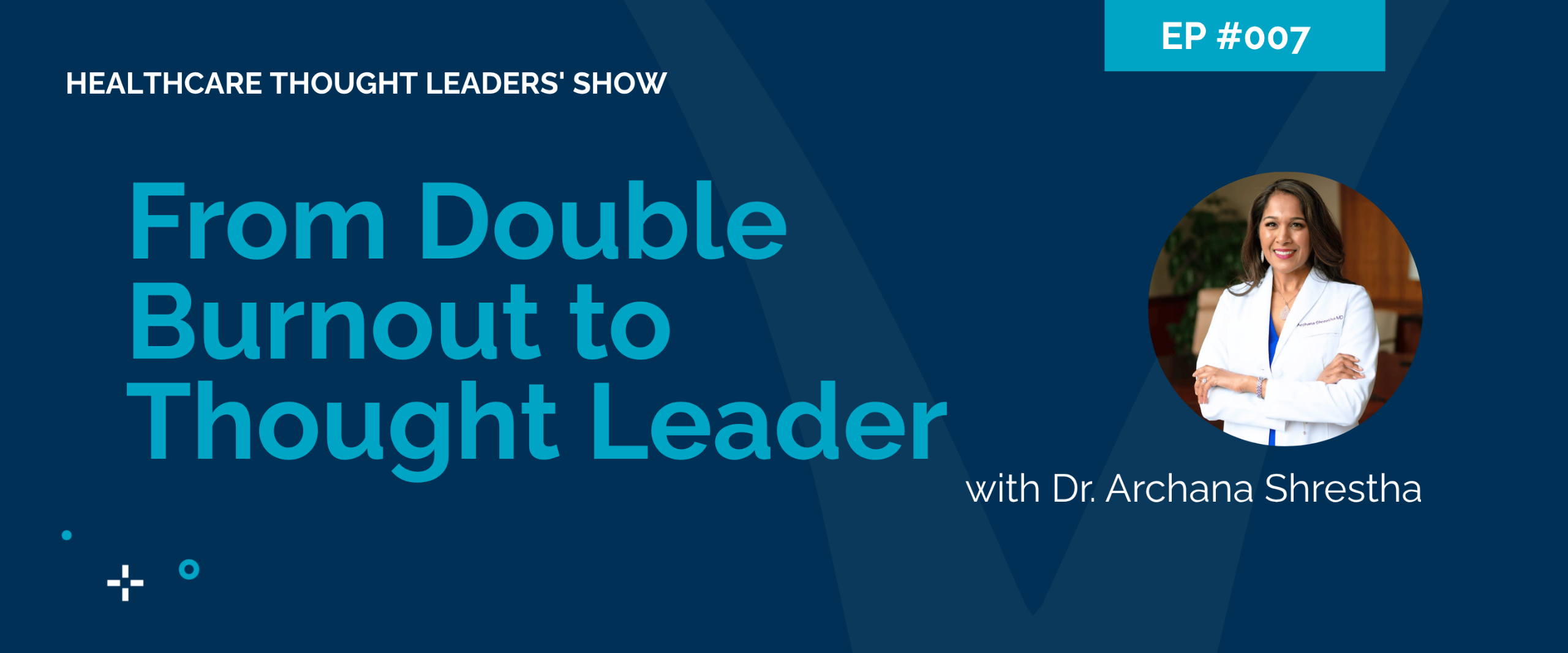
Megan Walker: Hello, and welcome to the Healthcare Thought Leaders Show. I'm Megan Walker, and today I'm joined by very special guest Dr Archana Shrestha, who is based in Chicago. Archana is an emergency physician, Chief Wellness Officer, international keynote speaker, and author of an amazing book called The Thrival Code: Recover From Burnout, Escape Survival Mode, and Thrive in Your Life and Career.
Having worked with thousands of health and medical professionals, I know this is a really hot topic. When I saw Archana's amazing posts on LinkedIn and Instagram, I thought, I just have to get her on this show and connect her with my audience here. After burnout herself while managing a high-pressure medical career and raising a family, Archana developed a practical approach to helping other high performers recover from burnout and create sustainable success. There's a thought leadership pivot in here that we're going to uncover today as well. Her evidence-based programs have achieved measurable reductions in burnout among participants. So Archana, welcome. Thank you so much for being here today.
Dr Archana Shrestha: Thank you for having me, Megan. I'm excited to talk with you.
Megan Walker: So good. You're an emergency physician and a mother. You've personally experienced burnout, which I imagine was super tough. What did that look like for you, and when did you realise that's what you were experiencing above the ordinary levels of stress you had in your life prior?
Dr Archana Shrestha: Great question, Megan. As an emergency physician, I was trained to handle stressful scenarios, and I fully expected my work to be stressful. But then I could go home and relax and have some downtime for myself. When I found that I was in burnout was actually after adding the role of mother to my resume. Working mom, and after having kids is when the wheels fell off.
I would go to my first shift working in the ER, all sorts of crazy hours: evenings, nights, holidays, weekends. Taking care of lots of intense cases, heart attacks, strokes, domestic violence, bad traumas. That was already mentally and emotionally draining. Then I would go home to the second shift of all the things we parents have to deal with, which oftentimes tends to fall on the shoulders of women more so than men. Even though I do have an incredibly supportive husband, my conditioning was that I was supposed to do it all. I was supposed to work full time, and also take care of everything that needed to be taken care of for my kids: the cooking, the cleaning, the childcare, taking them to activities, planning the parties, all of those things. And I was supposed to do that without missing a beat.
I started to feel, after I had my second child, that I was just exhausted all the time. I was overwhelmed. My wake-up call was that I was not showing up in the ways I wanted to. I knew I wasn't being the mother I wanted to be. I wasn't showing up in the way I wanted to in my relationship with my husband, and I even wasn't showing up as the best possible version of myself at work in the ER.
I had a couple of wake-up calls. One in particular I share the story in the book about. One day after the first shift, I came home to the second shift. My kids were really little. My son was about three years old, my daughter was about one, and I was home alone with them. It was that witching hour, 5 or 6 pm when kids start to have tantrums. They were probably hungry, and there I was in the kitchen trying to make a meal for them, and my son started to have this massive toddler tantrum. He was pounding his fists and stomping his feet.
In that moment, I had such a short fuse from my burnout. I was just constantly stressed and felt so much tension all the time, that I exploded. I started to react like him. I was pounding my fists and stomping my feet, kind of having an adult tantrum as well, and I lost my cool. As I did, my son stopped tantruming, but his eyes got really wide, he backed away from me, and he ran away saying, "Mommy's scary. Mommy's scary."
In that moment it was such a heartbreaking moment because this was not at all the mother I wanted to be. I wanted to be always connected with my kids, having lots of great moments with them. I wanted to be the fun mom, the one they would always come to. Later that evening, as soon as my husband came in the door, my son ran straight up to him and said, "Mommy's scary. Mommy's scary." In that moment is when I realised, you've got to do something. Something is wrong. This isn't just stress. This isn't just feeling overwhelmed or fatigued. This is burnout.
That's the difference. Burnout isn't just stress. It's where we start to show up differently. We have such a short fuse, very little patience. We're getting frustrated easily. We feel very cynical. It's really three types of exhaustion: physical, mental, and emotional. That sent me on a journey to try to work through it all. It took me quite some time, lots of mentors, some methods I had to develop myself, but over the next number of years I was able to come up with a method, and that's what I share in The Thrival Code.
Megan Walker: Amazing. Oh my gosh. Thank you for being so vulnerable. I'm sure absolutely everyone, myself included, who is listening has definitely been there. Parenthood puts a new spin on things where it's never really time for you to have your emotions. Everyone else's emotions even come first before the exhausted parent. That perception of keeping it going all the time is a hard bar to achieve, isn't it? So did that look different for you in terms of changing how you worked? Was it a situation where you felt you needed to lighten your load, or was it more that you needed to approach the load differently?
Dr Archana Shrestha: I came to realise that what I was experiencing is something I went on to call double burnout, because it was both professional burnout and parental burnout at the same time. Caregiver burnout, which can happen either as a parent or if you're caring for elderly parents, for example. I was facing this on two fronts. I really didn't think that cutting down my hours was going to make much of a difference. Plus, based on our family needs at the time, I knew I wanted to stay working full time.
My first thing was to try what we're commonly told to do, which is more self-care. I went ahead and did a lot more self-care. In fact, got myself a health coach to help me stay accountable, and I started to exercise more regularly, get more sleep, eat better nutrition, drink more water, all of these things that are so great for us. I even started doing more yoga and meditation. However, I was still burnt out.
I came to realise that because I had this professional rock bottom moment where I got the dreaded phone call that nobody ever wants to get from their boss, from my medical director, who said, "Archana, is everything okay with you? We're getting complaints from the nurses about how you're showing up, and that's not at all like you." I was so incredibly embarrassed and shocked, and I was so glad he couldn't see my face because we were on a phone call. As the shock and embarrassment wore away, I couldn't understand it. I was so baffled. How could I still be burned out despite all this self-care?
That's when I realised there are two other critical components, and the other two pieces were the mental exhaustion I was feeling and the emotional exhaustion I was feeling. While I was physically taken care of because of all the self-care I was doing, I still went to work with those same negative, unhelpful thoughts and attitudes. Also with a lot of feelings that were negative and uncomfortable, like stress, overwhelm, anxiety, the pressure. I wasn't really handling those, and I had no tools. I didn't know how to handle that.
I started to learn more, and I said, okay, well, I'm still burned out. I actually did know that I was burned out because we were taking these burnout surveys, and I would always come up high risk for burnout. So I knew objectively that I was still burned out. That's what sent me on a journey to understand the two other pieces of the puzzle.
Megan Walker: So good. What amazing personal insights you had, that you were able to go, hang on, I've got to do something about this. So the way you teach burnout and burnout recovery involves those three aspects. How can someone recognise which type of exhaustion they're experiencing, be it physical, mental, or emotional?
Dr Archana Shrestha: I have a quiz to help answer this question for people, because this is a very common question. People are like, okay, I understand that it's physical, mental, and emotional exhaustion, but which one is it for me? To be quite honest, for most of us it's a little bit of all of it, unless you're someone who has just a really incredible self-stewardship routine, as I like to call it. You take really great care of yourself, you're exercising regularly.
I would say most of us don't really know how to handle the mental exhaustion, which comes from a lot of thoughts running in our head. The problem is, we have a lot of thoughts in a day. Some people estimate 80,000 to 100,000 thoughts a day, and the problem is that the vast majority of them are negative thoughts. A lot of them are on repeat, so that's a lot of negative thoughts repeating in our head, which are sort of like our programming or conditioning that we may have picked up along the way, or been influenced by others on, or just patterns of thinking we've tended to have. We have to start to develop the skill of really looking at that and creating more awareness about our thinking. Thinking about our thinking. Thinking about which thoughts are helping me and which thoughts aren't. Most of us have never learned that skill.
The second skill, especially for many of us in healthcare, and I will say for physicians, I think our nurse counterparts are much better at this than we physicians, but we physicians don't know how to process our emotions. We're really much trained to just stuff them down and be these automatic robots and objective. We're not supposed to show much emotion with our patients, we're supposed to just collect the data, make objective diagnostic decisions and clinical decisions, and all of these things. So we're not at all taught how to handle emotions. Yet we are handling all sorts of things. Patients could be very ill, there could be tragic things happening within a family, patients can be dying of cancer, for example. We are seeing these things on a daily basis, and we have no idea how to process it.
Those are the skills we need to learn. So there's really the body, heart, and mind framework that I came up with, which is what I use to help explain this to people in terms of what they need to address. They need to address their body. They need to address their heart and overcoming emotional exhaustion. And then their mind, and the mind management or thought work. So there are all three components of this. It can be hard to tell. Maybe some people are reflective enough to analyse and see what it is. That's part of the reason why I created a quiz, because people were always wondering, which one of these is really dominant for me? Of the many people who have taken the quiz, I've found that everybody tends to have a little bit of everything.
Megan Walker: Again, so insightful. We've focused so much, correct me if I'm wrong, in the last few years on mental health and mental wellness, and building in what looks like wellness. But is that actually what we need? Doing that quiz first to go, well, let's do the diagnostic, no different to what you would do with a patient. Let's actually look at what we need to work on, rather than just, oh, I went and got my hair done, why don't I feel better now? Not enough, is it?
Dr Archana Shrestha: Exactly.
Megan Walker: Which leads to this next question. A lot of people feel, I'm experiencing burnout, so I better take some time off, or pull back, or go and have a massage, or try and build in some self-care, whatever that definition means for people. But why are those things often not enough to create that lasting recovery?
Dr Archana Shrestha: Right. A couple of different things on that point, Megan. You're exactly right. Don't get me wrong, I love going to get a massage, I love to get a pedicure, I love a spa day, and I'm not telling people not to do those things. By all means, do them. But what we need to understand is that those things probably are not going to solve burnout. Self-care means different things to different people. For many people, it does mean things like that, the spa day, the manicure, the pedicure, getting a haircut. Doing those, they're lovely, but just don't think they're going to take away your burnout.
That's why I like to use a different term, which is self-stewardship. This term has a different meaning to me in that, just like we're a steward of our car, our house, our money, and we have to take care of it, right, if we want it to run and function well for a long time, we have to do the same for our bodies.
This gets us into some of the very basic things, like our physiologic needs for sleep, for water, for movement, for getting outdoors, for healthy nutrition, for love and connection, physical touch with others. These are some of our most basic physiologic needs. If you look at Maslow's hierarchy of needs, which I'm sure many people are familiar with, at the very bottom are these things, our physiologic needs. The way the pyramid works, the Maslow's triangle, is that you have to address the very bottom first before you move on to the next thing, to love and belonging, and safety, and all the way to the top, which is self-actualisation, when we are achieving all the things we want to achieve, our highest goals. We're being all that we can be.
The problem is, as high achievers, that we tend to want to skip that bottom part and jump straight to the top. The second we set big goals, we start to throw out some of our most basic physiologic needs for sleep, exercise, outdoors, healthy nutrition. That's foundational to me, and that's the skill I teach to go along with the body part of this framework, the body, heart, and mind framework. The corresponding skill that addresses the physical exhaustion is self-stewardship.
To answer your question, what about time off? I think we can all remember a time we went on an amazing vacation or holiday, and it was like the best time ever. We rested, we ate good food, we got a lot of sunshine. Then we come back, and within a week or two, we're pretty much back to feeling the same way again. Overwhelmed, exhausted, burnt out. We're dreading work again. It's just gone very quickly. Again, don't get me wrong, I want everybody to take their vacations and holidays, but the thing is, it's just a temporary relief of the day-to-day stressors. It's not really addressing the underlying root issues, which are, are we taking good care of our bodies? Are we learning the skills we need to manage our minds? Are we learning to process our emotions? That's why it's deeper than that. I think if it were that simple, if it was just a matter of self-care and vacations, then nobody would be burnt out. But it's not that simple.
Megan Walker: Yes, oh, so well said. So we're not looking at a quick Band-Aid. It's actually getting the foundations right, treating ourselves the way we need to be sustainable over a longer period of time, not just a quick fix over the top. I love that.
Now, one of the reasons I also really wanted to have this conversation, not only from your burnout understanding and journey, which is so relevant to all of my listeners, but also because you have now moved into this shift that I call a healthcare thought leader. I have a lot of people who come and I help them make that transition, build out their education assets, and help them with their visibility. People arrive at that decision to step into that work for a number of different reasons. One, it can be their own health. Another, they want to get more time. Some folks have got caring roles that they want to have more flexibility around. There are all these different reasons, but one of the big commonalities is people who've built up this legacy of knowledge in health or their medical field and want to then share that with others. I get this really strong sense from you that that was a driving force in you writing your book and creating courses. Can you tell us that transition from, yes, I have this personal and professional experience, and now I'm presenting my knowledge in different formats?
Dr Archana Shrestha: Absolutely. As you were saying all of that, what came to mind is, your mess is your message. The different things you've gone through, the challenges you've faced can be something, because obviously it was a challenge you faced, you made it through the other side. Otherwise you wouldn't be standing there. Now you can go forward and teach that to others. That's basically my story.
I realised I was struggling, and I had to work through it. As I did, I brought in coaches to help me, and they started to encourage me. Then also other people started asking, hey, you seem like you've had a health transformation. You seem happier. You seem like you're doing so well. What's going on? How did you do that? That can become a natural bridge to start to recognise that you do have things to teach. And that's the other thing, you don't have to be that much further along than others. Maybe a few steps ahead. You don't have to be an extreme expert. I think you have to be a couple of steps ahead, and have a desire to help others. I think also key is understanding that your message is valuable, that you have something to say, that you have lived experiences, you have expertise, and people want to know that. To just decide that in yourself is the first mindset shift: that I have something to say.
In writing the book, I had coached hundreds of people, and I said, well, this method is helping them. It helped me, it helped them, and now I want to put it in a more accessible format. So I decided to do a book. But a book, it could be a podcast, it could be a course, it could be posting on social media. There are so many different formats. Whatever works best for each individual, I would say. I hope that answers your question.
Megan Walker: It so answered my question, because people often arrive at a meet and greet with me and say, I'm a psychologist, or I'm a geriatrician, and all of my clinical peers have the same knowledge that I do. And it's like, whoa, whoa, whoa, hang on. There cannot be anyone else who has the same 20 or 30 years' experience that you do as an individual. So that's always one, the uniqueness of the knowledge and wisdom that each clinician has is so powerful, and is only owned by them. And then you're so right that tapping into what's my driving heartfelt purpose, that connection is what will get people through the, oh, but I don't understand tech, I don't want to be on social media, all of those uncomfortable shifts from clinician to clinical educator and leader in this field. I think you get through those by tapping into that heartfelt mission, and that's what pushes you forward into this work. So you answered it beautifully.
Archana, I think people would now be really keen to hear about your programs. Where can they find out more about you and see the work you're doing, and follow you?
Dr Archana Shrestha: Absolutely, Megan. And one thing, if you don't mind, I just want to say is that I think all of us in healthcare are leaders already. Whether you have a title or not, we are leading patients, we're leading patient families, we are leading teams oftentimes, even if you don't have a title. Then you sort of just add in your thoughts, your perspective, your take on it, your expertise, and that's what makes you a thought leader. And then the willingness to share it. The willingness to share and know that your message matters.
But yes, Megan, people can find me at thethrivalcode.com, that's T-H-E, thrival, T-H-R-I-V-A-L, code, C-O-D-E.com, as well as @thethrivalcode on Instagram and Facebook. On my website, thethrivalcode.com, people can find my quiz, they can find a free master class that I host a few times a month called Million Dollar Burnout Mistakes, and they can also get a copy of my book by going to Amazon.
I have a couple of programs that I run. One is an eight-week program where we really dive deeper into the concepts that I shared tonight on this podcast, the body, heart, and mind framework. I also have a longer program called The Best Year Ever, which is for people who truly want to transform their lives, whether that's a health transformation, they want to end burnout and never feel burned out again, or maybe want to improve their relationships, go for those promotions, go for those raises, and really have a massive transformation in their life. Those are both amazing programs, and I would love for your listeners to check it out.
Megan Walker: Absolutely. I love how neat that is. Well done on building out that ecosystem. As a coach in this space, I'm so impressed that you've got it ready to go, and there's a message in that for everyone listening as well. Did you hear how Archana was able to direct you into what is going to be absolutely helpful for you as the listener? So well done on so many fronts, including your beautiful journey map that's there as well.
What's your final piece of suggestion or advice for people listening who have been inspired and can totally relate to your journey? Go and do Archana's quiz. But what would you also say to them as a hopeful message as we wrap up?
Dr Archana Shrestha: I want to say that you were meant to have it all, and all at the same time. I don't believe we were meant to sacrifice our health, our own wellbeing, our most important relationships for our career. I believe that we were meant to have it all. An amazing career that's fulfilling and impactful, incredible relationships both at work and at home, and also incredible health. Sometimes I say that and people are like, wow, that's a bold statement. I believe that because as a parent, anyone who's a parent could probably relate to this, and it's that we want our kids to have it all. We wouldn't want them to have friends at school but not be learning and getting good grades. We wouldn't want them to be good at athletics but have no friends. We want them to have it all. I believe that our creators wanted that for us. That's the first shift, to realise that you can have it all when you start to learn these skills and implement them into your life.
Megan Walker: Oh, so powerful. It really shifted some victim thinking there and into action. Thank you so much again for having this amazing conversation. Can't wait to get it out into the world and direct people your way so you can help more people improve their lives. Well done to everything you've achieved as well, Archana. Thanks so much for joining us today.
Dr Archana Shrestha: Thank you, Megan. It's been a pleasure.
Connect with Dr. Archana:
Website: https://thethrivalcode.com
Instagram: https://www.instagram.com/thethrivalcode/
Amazon: https://www.amazon.com/Archana-Shrestha/e/B08957P9KN
Sign up for “HealthCare Thought Leaders” and receive practical insights, trainings, podcast episodes and strategic resources to help you grow your visibility, authority and impact beyond one-to-one care.
We respect your privacy and won't ever share your details. Unsubscribe any time.