Watch the video...
Read the Transcript...
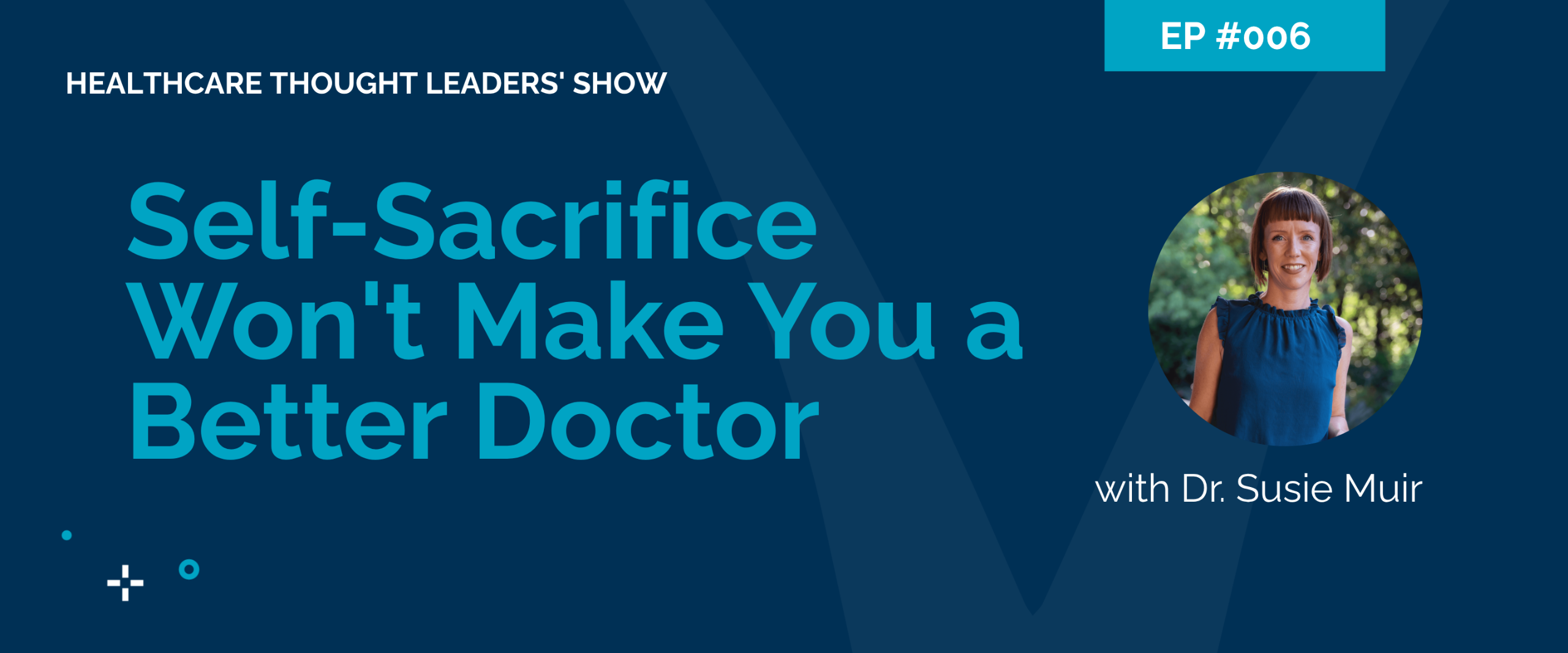
Megan Walker: Hello, and welcome to the Healthcare Thought Leaders Show. My name is Megan Walker, and today our very special guest is Dr Susie Muir, palliative care physician, speaker and advocate. Susie is redefining what high performance in healthcare really means. Through her work, she is challenging the culture of self-sacrifice in medicine, and helping clinicians build sustainable, fulfilling careers by putting humanity, recovery and purpose back at the centre of healthcare.
How refreshing. Susie's mission is simple but powerful: to create a healthcare system where caring for yourself is recognised as essential, and it's definitely a part of being able to care for others. So Susie, I'm delighted to welcome you to the Healthcare Thought Leaders Show, and thank you so much for being here.
Dr Susie Muir: Thank you, Megan. Delighted to be here.
Megan Walker: Amazing. As all of you listening will know, I typically talk to people in the context of becoming a healthcare thought leader. Susie, you've been on that journey. What led you from the clinical practice side into becoming more and more of a recognised voice around healthcare culture and wellbeing?
Dr Susie Muir: To be honest, I still find it strange to think that I'm starting to get my message out there, and it's really exciting. I'm still working almost full time clinically in palliative care at the moment, and I've been building all of this on the side, I suppose, for the last two or three years. But in honesty, I think it really started a long, long time before that, with all the thoughts that were swirling around in my head. My hope is that eventually I'll be able to change the breakdown of my week, so that I'm still doing a bit of clinical, but able to do this a lot more.
Megan Walker: Wow. Question without notice, because I can't let that go untouched. You're already a full-time clinician doing amazing, important work in palliative care, recognising that it is hard work. What's driving you, instead of sitting on the couch and having a glass of wine, to be there creating materials and putting things together? Tell me about that underlying driver, what's fired you up to create these materials.
Dr Susie Muir: Thanks, Megan. I'd love to chat about that. Since the start of my career, which is 20 years ago this year, I have really believed that we've got it a bit backwards in healthcare. This notion that doctors and healthcare professionals should just give, give, give everything to their patients without any regard for themselves, I think has really contributed to the culture we're in, which is self-sacrifice, endurance, we're all fine, we don't need support.
My belief is that that's changing. People are starting to recognise that those things, the self-sacrifice and the endurance, can be really damaging to ourselves, to our families, even potentially to our patients. Things like burnout are getting a lot more airtime in the media, and people are talking about physical and mental ill health, and all the ramifications of a chronic lack of caring for ourselves.
I've had that belief right from the start, but I've never really felt able to talk about it, because people were like, oh, well, that's just weird, just get on with it. So I've been really excited that in the last few years there's an increasing focus on that. That, coupled with my work in palliative care, which for the last nine years is really a daily reminder of this precious thing we call life and the fact that we only get one of them. I thought, right, this is something I want to be part of.
I find it so energising to sit and work on all of this in my evenings when I can, because I honestly believe it's essential to support people in health to care for themselves, and to learn and understand the really intentional strategies they can implement, so they can have this deeply fulfilling career, this rich personal life. I find it so energising, and that's what keeps me going. If you chase the things that bring you energy, then you can just really do that a lot.
Megan Walker: Oh, so good. You've given me goosebumps. It's one of my favourite parts of what I do, when I see people putting out good work and information that's really heart-driven and really helpful, I think, there's a burning flame in that person, I need to find out what theirs is. And so interesting what you say about the daily reminder in palliative care. It's not a dress rehearsal. Let's get on with it.
Dr Susie Muir: Very much.
Megan Walker: Amazing. How has stepping into thought leadership enabled you to create impact beyond the patients you can see personally?
Dr Susie Muir: At the moment, because I'm still fairly early on in this whole venture, I'm only just beginning to realise the impact that could come from this, and that is coming already. The amazing connections I've made with people both in Australia and around the world, through social media and through my website. People just spontaneously getting in touch, sharing that what I'm doing is helping and is needed.
My belief is that if I can keep that going, if I can be part of supporting healthcare professionals to build sustainability into their career, that will help so many of our patients. Because really, if all of our healthcare professionals are burning out, and the stats are really worrying as I'm sure you know, and people now are making new choices, they're considering careers elsewhere. There's a lot more understanding of choice in the world these days. If we lose our profession to burnout or because they leave, then that is, I believe, a real problem and a crisis that's kind of here already.
I'm still learning the impact all of this can have, but I've been absolutely delighted, overwhelmed, all of those words, by the number of people getting in touch just saying, thank you, what you're doing is meaningful and is helpful.
Megan Walker: Oh, validation. I love that. So good. You're absolutely on the right track. So what have you put in place so far? Are you writing books? What are your modalities for getting information to your audience?
Dr Susie Muir: Right now, for the last two years, I've been focusing on getting my thoughts out of my mind and trying to bring some order to them. I've been working with an amazing team. Their new company is called Thinkers Inc, and they are phenomenal. Stacey and Evelyn, they're a strategist and a designer, and working with them for a couple of years before all of this has been awesome, to understand what I'm actually trying to do, to build some frameworks I can then repeatedly use to support people, but in a very individual way.
Now my focus is running workshops. I'm launching my first workshop later in the year, which I'm really excited about, and building my connections through social media, getting on podcasts. My dream would be to write a book. I hope that's in the future. It's hard to know really where all of this could go, but every day that passes, I'm feeling more energised by it. So yeah, watch this space, I guess.
Megan Walker: Amazing. Oh, so exciting. What advice would you give to fellow clinicians who have an important message, they've got that evidence-based information within themselves and within their clinic, but they're feeling that hesitation? Worried about AHPRA, worried about what other people would say, the imposter syndrome, all of those things. What would you say to those folks to encourage them to put themselves out there?
Dr Susie Muir: I can really relate to all of those things. My main advice would be, connect with people. Find other people who are doing maybe a similar thing, or different but kind of the same. Get in touch with them. I was new to social media up until December of last year. I'd avoided it my whole life. Didn't even know what LinkedIn was. I had to Google what is LinkedIn and how do I use it. Since then, I've honestly met some amazing people around the world, just by sending a message and saying, I love what you're doing, tell me more. That's been really mind-opening, to understand that not only are there other people doing really cool things, but how they got there. So that would be my first advice: get in touch with other people that you're like, oh, I'd love to do something similar. Learn from them. Swap some stories.
My next bit of advice would be to work with a team who understand how to make this a real thing. I know nothing about marketing. I know nothing about business. So I kind of floundered a bit for about a year before all of this, trying to do it myself, and I think I needed to do that. I needed to give it a crack. But when I started working with Stacey and Ev, it was like, oh, game on. Okay. They know what they're talking about. I can talk about what I know. We work together, and now I feel like we're starting to move forward.
Megan Walker: Oh, that's so good. It's such an evolution. It's not a quick process, is it? Because the amount of mental change you've got to give, from clinically trained service delivery to now, hang on a minute, this is global, global thinking, global concepts, change-making. You've got to sit with that for a while to let the overwhelm settle, and keep pushing through some of that in order to get the results. So congratulations on doing that, because it's a process, well and truly.
Dr Susie Muir: Exactly.
Megan Walker: I want to talk now about your vision, and also then how people can get in touch with you. If you could change one thing about the culture of healthcare over the next decade, what would it be, and what role do you think healthcare thought leaders can play in making that happen?
Dr Susie Muir: For me, it's really simple. We've got to bring the humanity back across all levels of health, starting with how we treat each other as the staff, as the team. No matter what you do in healthcare, you play a vital role, whether you're seeing patients directly, whether you're doing more of the back-end stuff. Whatever it is, you're vital, and we must start connecting as humans with respect and with value of each other. That is where a true culture change is going to come from, and that will then spill over into how we work with our patients as well.
This whole notion that there's doctors and there's patients, of course I get it, but really every human is a patient either now, in the past, or in the future. It's not this big divide. I think trying to find this shared understanding, that is the central core of humanity, is the key. Then really it will move from there. So that would be my one thing: bring the humanity back. That's my mission.
Megan Walker: I love that. How can people work with you? How can they get in touch with you?
Dr Susie Muir: My website, drsusiemuir.com, is the place to go. It's got a lot more information about what I'm doing and the services I'm offering. My main focus at the moment, as I mentioned, is my two-day workshop, which is called High Performance Redesigned. It's a small workshop with 16 participants maximum. I'm a trained coach as well, so the workshop will be a coaching-informed workshop, building connection through the participants, and really helping people to step back from their identity as doctors, or any healthcare professionals can come along. To step back from that and re-embrace our own humanity, to find out who we are underneath all of that and what we really want from our life, and then to work through understanding a bit about the huge influence the system plays, and the fact that most of the drivers of burnout are system factors, not individual factors. Helping people to understand that, but then looking at, well, what control do we have over ourselves, over our team, over the system.
I'm really excited about that workshop. Certainly if anyone was keen, they could connect with me through the website. I also do keynote speaking, which I'm just branching into and excited to do. I'm happy to do boutique workshops. I did one last week, a small 90-minute taster, which went really, really well. The main message is, if anyone was keen to work with me, just drop me a message through the website, and we'd work together to figure out what it looks like.
Megan Walker: Beautiful. Congratulations, Susie, on all the amazing work you're doing. Can't wait to see all of this unfold, and more and more workshops, and just that scalability. Is that one of the things you're most excited about, the impact you can have through workshops and bigger platforms? That must be really exciting to move into that one-to-many space as well.
Dr Susie Muir: I hope so. The reason being that the feedback has been so positive about the instantly applicable strategies people learn. So being able to get that out on a bigger scale would just be wonderful, to think that more and more people were able to just change their lens a little bit. As you talked about with mindset, just change your mindset a little bit about what it means to work in health and what it means to be human. If that can get out to the masses, then I'm excited for that.
Megan Walker: So good. Thank you so much for talking to us today. I know that folks listening would be really inspired. They love hearing about other people's journeys, stepping out of the confines and looking at more innovative ways to reach and have impact, and you're doing exactly that. Thank you so much, and I just encourage everyone listening to find that burning light within and do it. Hey, Susie, tell them to do it.
Dr Susie Muir: Oh, absolutely do it. There's probably so much you can give to the masses, to the world. It's just having that confidence to take that step. Certainly if anyone wanted to contact me just about, hey, how do you even start this, then happy to chat to anyone.
Megan Walker: Oh, that's so generous of you. Thank you again, Susie. We've absolutely loved having this conversation, and can't wait to see you soon. Susie's details are below in the transcript. Go and have a look at her website and check out her upcoming workshops as well. Thank you so much, Susie. We'll talk to you soon.
Dr Susie Muir: Thanks, Megan. Thanks for having me.
Connect with Susie:
Website: https://drsusiemuir.com/
Instagram: https://www.instagram.com/drsusiemuir
Sign up for “HealthCare Thought Leaders” and receive practical insights, trainings, podcast episodes and strategic resources to help you grow your visibility, authority and impact beyond one-to-one care.
We respect your privacy and won't ever share your details. Unsubscribe any time.